Prediction market fees explained (Kalshi, Polymarket and others)
Trading fees, the spread, and deposit and withdrawal costs. What you really pay, with worked examples.
Short answer: You pay three kinds of cost on a prediction market: a trading fee on each contract (on most platforms), the spread (the gap between buy and sell prices), and sometimes deposit or withdrawal fees. Trading fees are usually highest on 50/50 markets and lowest near 1¢ or 99¢. Always check the fee schedule on the platform before you trade (checked 27 September 2026).
1. Trading fees
Kalshi
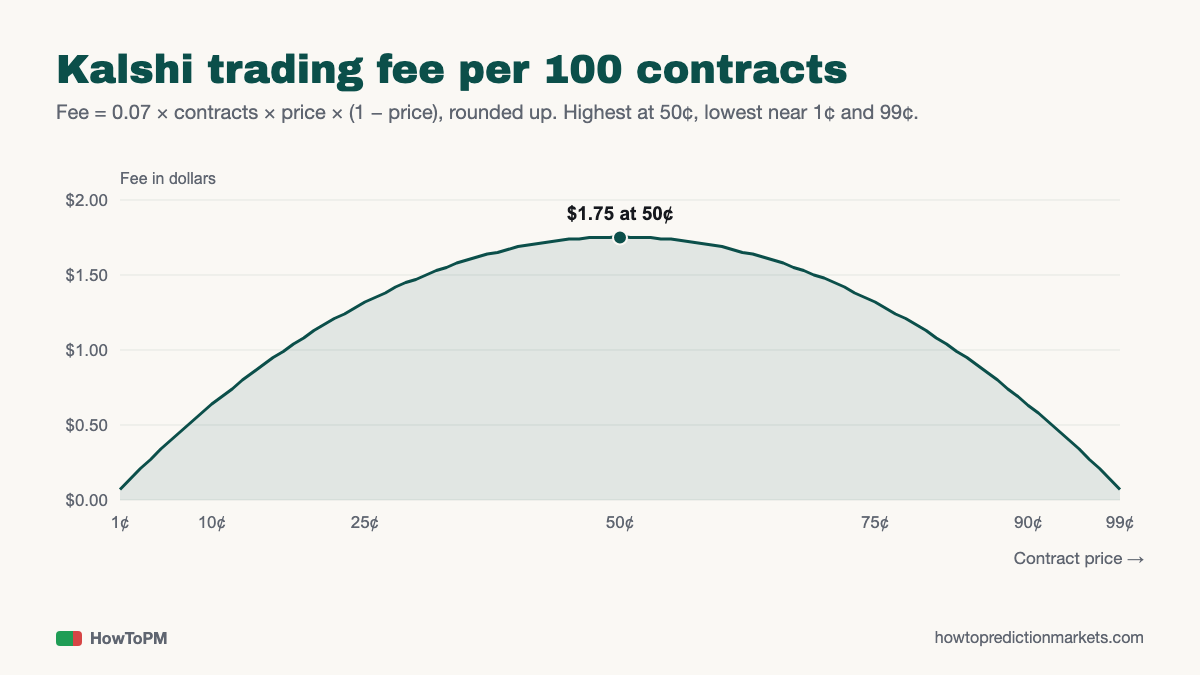
Kalshi publishes a formula. For most markets, the fee for taking a price is:
fee = 0.07 × number of contracts × price × (1 − price), rounded up to the next cent.
| Price | Fee per 100 contracts |
|---|---|
| 10¢ | $0.63 |
| 30¢ | $1.47 |
| 50¢ | $1.75 |
| 70¢ | $1.47 |
| 90¢ | $0.63 |
Some markets use a different multiplier, and resting (maker) orders may pay less. Source: Kalshi's published fee schedule, checked 27 September 2026.
Polymarket
Polymarket has historically charged no trading fee on most markets, with fees on some fast-moving markets. The US iPhone app has its own fee terms. Check the fee line on the order screen before you confirm.
ProphetX and Novig
Both run CFTC-regulated, peer-to-peer sports exchanges, so the price is set by other users rather than a house margin. They earn through a commission on some trades or through how their pricing works. Novig, for example, charged no commission on pre-game single trades as of 27 September 2026, while reports say live in-game trades and parlays carry a taker fee built into the price. Read the fee section in each app before trading. See our ProphetX review and Novig review.
2. The spread
If you can buy Yes at 55¢ but only sell it at 52¢, you lose 3¢ the moment you buy. On busy markets the spread is often 1¢; on quiet ones much wider. Using limit orders helps you avoid paying the full spread.
3. Deposits and withdrawals
- Bank transfer (ACH): usually free, a few days to arrive.
- Debit card: instant, sometimes with a small fee.
- Crypto (USDC): common on Polymarket; network fees may apply.
- Wire: fast for large amounts; banks often charge.
Worked example
Try any trade in the odds converter with the fee option ticked.
You buy 100 Kalshi Yes contracts at 50¢ = $50.00, plus a fee of $1.75. The market settles Yes and you receive $100.00. Profit: $48.25. If you'd bought at 90¢ instead, the fee would be $0.63, but your profit if right would only be $9.37.
Read next: Limit orders vs market orders: how resting orders can cut your fees.
Frequently asked questions
Which prediction market has the lowest fees?
It depends on the market and price. Polymarket has charged no trading fee on many markets, while Kalshi's fee is predictable and lower near 1¢ and 99¢. Peer-to-peer sports exchanges can be cheap on popular games. Compare the total cost (fee plus spread) for the trade you want.
Do I pay a fee if I lose?
On Kalshi the trading fee is charged when your order is filled, win or lose. There's no extra fee at settlement on most markets.
Are there fees for holding a position?
Generally no. Some platforms pay interest or rewards on balances or open positions; check the current terms.