Limit orders vs market orders on prediction markets
The order book in plain English, with a worked example in cents.
Short answer: A market order buys or sells right now at the best prices other traders are offering, so it fills fast but you can pay more than you expected. A limit order sets the most you'll pay (or least you'll accept) and waits until someone matches it. On prediction markets, where many markets are thin, limit orders usually save money. On Kalshi they can also cut fees, because resting (maker) orders pay no fee on most markets.
On this page
Kalshi offer, checked 27 September 2026
Trade $25, get $25
Promo code: WINPREDITCS
Certain limitations apply. The offer is available to new users only, subject to the terms and conditions at kalshi.com/tc/500. 18+ only. Restrictions and eligibility requirements apply. Event contract trading involves significant risk and is not appropriate for everyone. Please carefully consider if it is appropriate for you in light of your personal financial circumstances. Kalshi products are not available in all jurisdictions. See kalshi.com/regulatory for more information. Terms apply.
What is the order book?
Exchanges like Kalshi and Polymarket don't set prices. They match traders. Every open offer sits in an order book:
- Bids are offers to buy. The highest bid is the best price you can sell at right now.
- Asks (or offers) are offers to sell. The lowest ask is the best price you can buy at right now.
- The spread is the gap between them.
Here is an example book for Yes on a market:
| Side | Price | Contracts available |
|---|---|---|
| Ask | 46¢ | 200 |
| Ask | 44¢ | 100 |
| Ask | 43¢ (best ask) | 50 |
| Bid | 41¢ (best bid) | 80 |
| Bid | 40¢ | 150 |
| Bid | 39¢ | 300 |
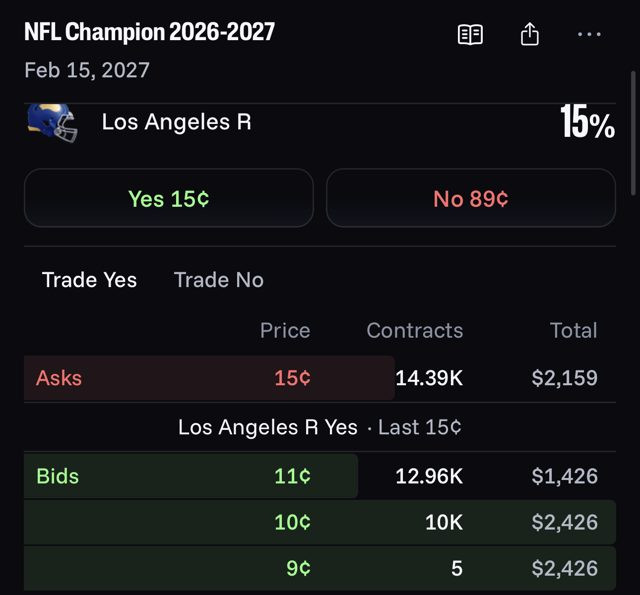
And here is a real one: the Yes order book for "Los Angeles R" in OG's NFL Champion 2026–27 market (screenshot, 27 September 2026). Sellers were asking 15¢ for about 14,390 contracts, while the best buyers were bidding 11¢, a 4¢ spread:
In the example table, the spread is 2¢ (43¢ minus 41¢). Because Yes and No always add up to $1 at settlement, a Yes bid at 41¢ is the same as a No offer at 59¢. That's why the Yes and No prices on Kalshi mirror each other. If prices are new to you, start with how to read prediction market odds.
What is a market order?
A market order says: "Fill me now at whatever the book offers." It takes the best ask first, then the next one, and so on, until your order is filled.
- Pro: instant, almost certain to fill.
- Con: you pay the spread, and on a large order you can walk the book into worse prices. The difference between the price you saw and the average price you paid is called slippage.
Many apps protect you with a maximum cost or price limit on market orders. Check what yours shows before confirming.
What is a limit order?
A limit order says: "Buy at 42¢ or better, and only then." If a seller is already at that price or lower, it fills at once. If not, your order rests in the book as a new bid and waits.
- Pro: you control the price. No slippage beyond your limit.
- Con: it may fill only partly, or not at all, if the price moves away.
Most platforms let you cancel a resting order any time before it fills. On Kalshi, cancelling costs nothing.
Maker vs taker: why it matters for fees
- A taker removes an order from the book. Market orders, and limit orders that match straight away, are taker trades.
- A maker adds an order that rests in the book. A limit order that waits and is later filled is a maker trade.
Kalshi (fee schedule effective 7 July 2026, checked 27 September 2026):
- Taker fee: 0.07 × contracts × price × (1 − price), rounded up to the next cent.
- Maker fee: zero on most markets. On the specific series Kalshi flags for maker fees, it's 0.0175 × contracts × price × (1 − price), a quarter of the taker rate.
- No fee for cancelling a resting order, and no settlement fee.
Polymarket has charged no trading fee on many markets, with fees on some. The US app has its own fee terms. The fee line on the order screen is the final word. See prediction market fees explained for the full picture.
Worked example: buying 200 Yes contracts
Using the order book above on Kalshi, you want 200 Yes contracts.
Option A: market order
Your order sweeps the asks:
| Fill | Cost | Taker fee |
|---|---|---|
| 50 at 43¢ | $21.50 | $0.86 |
| 100 at 44¢ | $44.00 | $1.73 |
| 50 at 46¢ | $23.00 | $0.87 |
| Total | $88.50 | $3.46 |
Your average price is about 44.3¢, not the 43¢ you saw at the top. With fees you pay $91.96. That extra 1.3¢ per contract is slippage.
Option B: limit order at 42¢
You place a bid at 42¢, which becomes the new best bid. If sellers come to you and it fills in full:
- Cost: 200 × 42¢ = $84.00
- Maker fee: $0 on a standard Kalshi market, or $0.86 on a series flagged for maker fees.
Saving: about $7 to $8 on the same 200 contracts. If Yes wins, both pay $200, so the limit order would make roughly $116 profit against about $108 for the market order.
The catch: if big news pushes Yes to 60¢ before anyone sells to you at 42¢, your order sits unfilled and you miss the move. That's the trade-off.
When should you use each?
Use a limit order when:
- The spread is wider than 1¢ or 2¢.
- You're trading more than the top price level can fill.
- The market is quiet: niche economics, weather or culture markets, or sports far from game time.
- You're happy to wait and don't mind missing the trade.
A market order can be fine when:
- The market is busy, the spread is 1¢ and your order is small against what's on offer.
- Speed matters more than a cent or two, such as right after a news event.
- You're closing a position and just want out.
Even then, many experienced traders use a limit order at the current best ask. It fills immediately like a market order but can never slip past that price.
Beginner tips
- Look at the book before you trade. Most apps show it under the price chart.
- Start small. Our first trade guide walks through the order screen.
- Watch resting orders. A forgotten limit order can fill days later when the situation has changed. Cancel what you no longer want.
- Count the total cost: price, spread, slippage and fees. Try the numbers in our profit calculator.
- Only trade money you can afford to lose. See responsible trading.
Frequently asked questions
Should beginners use limit or market orders?
Limit orders, in most cases. They stop you paying more than you meant to, which matters on thin prediction markets. Set the limit at or near the best ask if you want a quick fill.
Does Kalshi charge maker fees?
On most markets, no. Kalshi charges maker fees only on series it flags in its fee schedule, at a quarter of the taker rate (checked 27 September 2026).
What is slippage in prediction markets?
The difference between the price you expected and the average price you actually paid. It happens when your order is bigger than the amount offered at the best price.
What happens to an unfilled limit order?
It stays in the order book until it fills, you cancel it, it expires (if you set an expiry), or the market closes. Unfilled orders cost nothing on Kalshi.
Why is the spread so wide on some markets?
Few traders are active, so there are fewer offers close together. Wide spreads are common on niche or brand-new markets and far from the event.