What are prediction markets? A plain-English guide for beginners
You buy "Yes" or "No" on a real-world question. If you're right, each contract pays $1. Here's everything else a beginner needs to know.
Short answer: A prediction market is an exchange where you buy and sell contracts on yes-or-no questions about the future, like "Will the Fed cut rates in December?" Each contract pays $1 if the answer is Yes and $0 if it's No. The price, between 1¢ and 99¢, is the crowd's estimate of the chance it happens: 70¢ means roughly a 70% chance.
On this page
A simple example
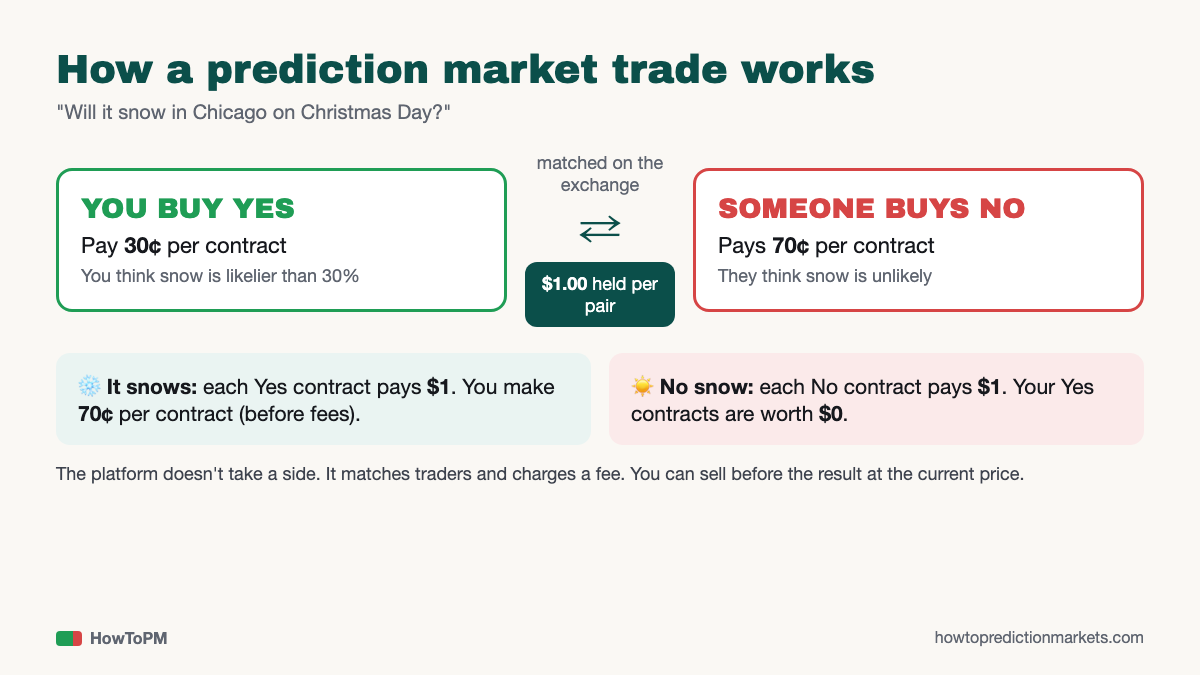
Say a market asks: "Will it snow in Chicago on Christmas Day?" The "Yes" price is 30¢.
- You think snow is more likely than 30%, so you buy 10 Yes contracts for $3.00.
- If it snows, each contract pays $1: you get $10.00, a profit of $7.00 (before fees).
- If it doesn't snow, your contracts are worth $0 and you lose the $3.00.
Someone else bought "No" at 70¢ because they thought snow was unlikely. You're not betting against the platform, you're trading with that person. The platform just runs the exchange and charges a small fee.
What can you trade?
In the US, regulated prediction markets offer contracts on:
- Economics: interest rates, inflation (CPI), jobs numbers, gas prices
- Politics: elections, bills, appointments (availability varies by platform)
- Sports: game winners, championships and more, on most apps
- Culture and weather: awards, box office, temperatures, snowfall
- Finance and crypto: index levels, Bitcoin price ranges
Why are they called "markets"?
Because prices move with supply and demand, just like stocks. When news breaks (a player gets injured, a poll comes out) people buy and sell, and the price changes within seconds. That's also why you don't have to wait for the result: you can sell your contracts early, locking in a profit or cutting a loss.
How is this different from betting at a sportsbook?
At a sportsbook, the company sets the odds and takes the other side of your bet. On a prediction market, other users set the prices and the platform charges a fee instead. That difference matters for price, limits and regulation. We explain it fully in Prediction markets vs sportsbooks.
Are they legal?
Kalshi, Polymarket's US app, OG, ProphetX and, since August 2026, Novig operate as exchanges regulated by the Commodity Futures Trading Commission (CFTC), the federal agency that oversees futures. Rebet uses a different, sweepstakes-style model. Several states are challenging sports contracts in court, so availability differs by state. Read Are prediction markets legal? for the current picture (checked 27 September 2026).
Where to start
- Read how to read prediction market prices. It takes five minutes.
- Pick an app with our best prediction market apps guide.
- Follow the step-by-step sign-up guide, for example how to sign up for Kalshi.
- Start small. Treat your first few trades as the cost of learning.
- Coming up: the 2026 midterms, the NBA season and the World Series.
Frequently asked questions
Are prediction markets gambling?
Legally, the regulated US platforms are exchanges for "event contracts", overseen by the CFTC, not gambling sites. In practice the risk is similar: you can lose everything you put into a contract. Some states argue that sports contracts are gambling, and that question is being decided in the courts.
How do prediction markets make money?
Mostly through trading fees charged on each contract, and sometimes on deposits or withdrawals. They don't need you to lose, because you're trading against other users. See prediction market fees explained.
Are prediction market prices accurate?
Often surprisingly so, because people with money at stake have a reason to be right. But they aren't guarantees: a 90¢ contract still loses about one time in ten.
How much money do I need to start?
Many apps let you start with a few dollars; contracts can cost as little as 1¢. Sign-up offers often need a minimum deposit or trade, such as $10 to $50.