How are prediction markets settled?
Who decides the outcome, when you get paid, and what happens when a result is disputed.
Short answer: Every prediction market has written rules that name the exact question and an official resolution source (a government agency, league or other authority). When that source confirms the result, winning contracts pay $1 each and losing contracts pay $0. Regulated US exchanges like Kalshi and Polymarket US settle markets themselves under their CFTC-approved rules. Polymarket's international site uses the UMA optimistic oracle, where anyone can propose or dispute an answer.
On this page
What does "settled" mean?
A prediction market goes through three stages:
- Close. Trading stops. This can happen before, during or after the event.
- Determination. The platform checks the result against the source named in the rules.
- Settlement. Your balance is updated. Each winning contract pays $1.00 and each losing one pays $0.00.
So if you bought 100 Yes contracts at 40¢ ($40) and the market settles Yes, you receive $100. Your profit is $60, before fees. If it settles No, you receive nothing and lose the $40. You never owe more than you paid for a contract.
Why the rules matter more than the headline
The market title is a summary. The rules decide the payout. They say:
- The exact condition for Yes (for example, the target range published in the Fed's official statement).
- The source used to check it, such as the Federal Reserve, the Bureau of Labor Statistics, the National Weather Service or a league's official stats.
- The deadline and what happens if the event is delayed.
- Edge cases: overtime, postponed games, a player who doesn't play, data revisions.
Here's what the rules look like on a real Kalshi market (screenshot from our editor's account, 27 September 2026). The rules name the condition for Yes and the sources used to verify it:
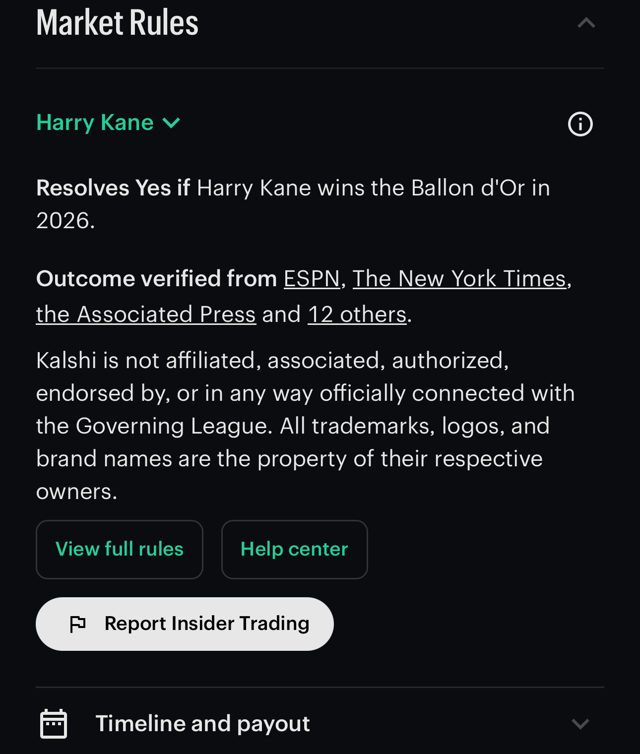
Most "I was robbed" complaints come from traders who read the title but not the rules. Read them before every trade. Our first trade guide shows where to find them.
How does Kalshi settle markets?
Kalshi is a CFTC-regulated exchange (a designated contract market). Each contract has terms filed with the regulator that name a source agency. According to Kalshi's help centre (checked 27 September 2026):
- Most markets settle within about 3 hours of the outcome being known.
- It can take longer when the source is slow to publish or revises its data, or when the rules set a later determination time.
- A market that's still open after the event doesn't mean it lost. Kalshi often waits for the official figure.
- Revisions published after settlement generally don't change the payout.
Each market also has a Timeline and payout section. On the market below, Kalshi showed when it opened, that it closes once the outcome occurs, and a projected payout 30 minutes after closing. It also explains "collateral return": in an event where only one answer can win, holding No on several answers can free up some of your money early.
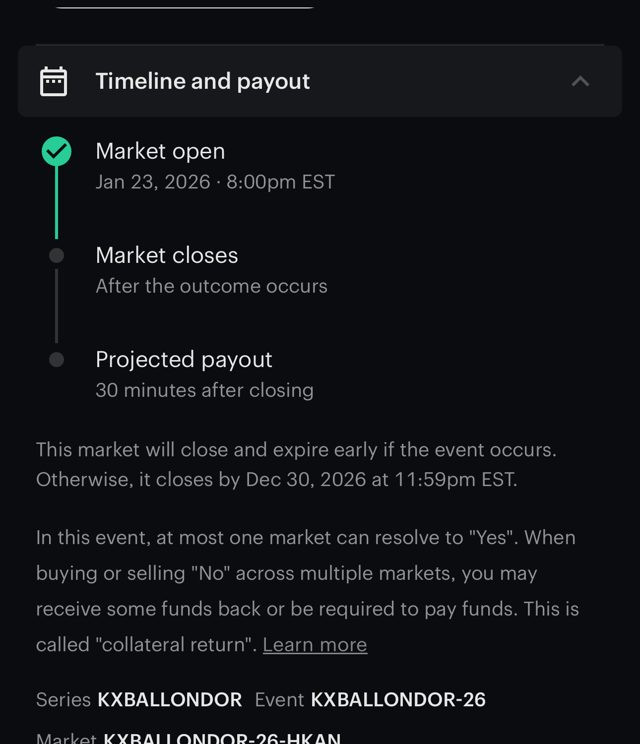
When the result is unclear, Kalshi's rulebook allows an Outcome Review process. A committee reviews the evidence and decides the outcome, normally within 24 hours of starting the review. Its decision is final.
When the outcome can't be determined at all, the rulebook lets Kalshi settle at the last traded price instead of $1 or $0. For example, if Yes last traded at 10¢, Yes holders get 10¢ and No holders get 90¢. Some sports contracts use a similar "fair value" payout when, say, a player doesn't take part. The payout rule for your market is in its terms.
Kalshi offer, checked 27 September 2026
Trade $25, get $25
Promo code: WINPREDITCS
Certain limitations apply. The offer is available to new users only, subject to the terms and conditions at kalshi.com/tc/500. 18+ only. Restrictions and eligibility requirements apply. Event contract trading involves significant risk and is not appropriate for everyone. Please carefully consider if it is appropriate for you in light of your personal financial circumstances. Kalshi products are not available in all jurisdictions. See kalshi.com/regulatory for more information. Terms apply.
How does Polymarket settle markets?
Polymarket runs two different systems, and they settle differently.
Polymarket US (the regulated app)
The US app is a CFTC-regulated exchange. It does not use blockchain voting. Settlement is handled centrally by Polymarket Clearing under the Polymarket US rulebook and each market's published rules, which name official sources. Winning contracts pay $1.00, losing ones $0.00, and some markets have special settlement terms written into the market. Polymarket's US documentation says all settlements are final under the rulebook. See how to use Polymarket in the US.
Polymarket international (the crypto site)
The international site, which isn't open to US users, uses UMA's optimistic oracle. "Optimistic" means an answer is assumed correct unless someone challenges it. Per Polymarket's help centre (checked 27 September 2026):
- After the event, someone proposes an outcome and posts a bond, typically $750 in USDC.
- A 2-hour challenge window follows. If nobody disputes, the market resolves.
- Anyone can dispute by posting a matching bond.
- A disputed question goes to a debate period (24 to 48 hours), then UMA token holders vote (about 48 hours).
- The losing side forfeits its bond. Once UMA finalises the result, Polymarket can't reverse it.
Some price-based markets (for example, crypto prices) use automated data feeds instead.
Kalshi vs Polymarket settlement at a glance
| Kalshi | Polymarket US | Polymarket international | |
|---|---|---|---|
| Who decides | Kalshi, under CFTC-filed rules | Polymarket Clearing, under its rulebook | UMA proposers and, if disputed, UMA token holders |
| Regulator | CFTC | CFTC | Not US-regulated |
| Typical time | Often within ~3 hours of the result | Shortly after the official result | ~2 hours if undisputed; several days if disputed |
| Disputes | Internal outcome review | Under the exchange rulebook | Bonded challenge and token-holder vote |
| Paid in | US dollars | US dollars | USDC |
For more differences, see Kalshi vs Polymarket.
Can a market close early?
Yes. If the rules' condition is met before the deadline, the market can close and settle early. A "Will X happen by December 31?" market can settle Yes in October if X happens in October. Markets can also stop trading shortly before an event for operational reasons, even though settlement comes later.
What if a market is cancelled or voided?
It's rare, but it happens: a game is abandoned, a source stops publishing or the question becomes impossible to answer. What you get depends on the rules:
- Kalshi: usually settlement at the last traded price or a fair value set by the Outcome Review Committee, as described above.
- Polymarket international: UMA voters can return a rare 50-50 result, where each Yes and each No share pays 50¢.
- Polymarket US: follow the fallback terms written into the market.
What should you do while waiting?
- Nothing, usually. Settlement is automatic. You don't have to claim winnings on Kalshi or Polymarket US.
- Don't panic-sell into a thin market just because settlement is slow.
- Check the rules and the source if something looks wrong, then contact the platform's support.
- Want your money out? Once settled, winnings are normal cash. See how to withdraw from Kalshi.
Frequently asked questions
How much does a winning prediction market contract pay?
$1.00 per contract on Kalshi and Polymarket. Losing contracts pay $0. A few markets pay a partial amount if the outcome can't be determined.
How long does Kalshi take to settle a market?
Most markets settle within about 3 hours of the result being confirmed, according to Kalshi's help centre. It can take longer if the official source is delayed.
Can a settled market be reversed?
Generally no. Kalshi's outcome review decisions are final, Polymarket US says settlements are final under its rulebook, and UMA-finalised results on the international site are immutable.
Who decides the outcome on Polymarket?
On the US app, Polymarket Clearing settles markets using the sources in each market's rules. On the international site, the UMA optimistic oracle decides, with a token-holder vote if an answer is disputed.
Do I need to do anything to get paid?
No. On Kalshi and Polymarket US, winnings are added to your cash balance automatically once the market settles.