How do prediction markets work? Contracts, prices and payouts explained
Contracts that pay $1, prices set by other traders, and how you can sell before the result. The mechanics, step by step.
Short answer: Every market is a yes-or-no question. A "Yes" contract pays $1 if the answer turns out Yes; a "No" contract pays $1 if it's No. Traders buy and sell these contracts with each other at prices between 1¢ and 99¢. When the event is over, the market "settles": winning contracts pay $1, losing ones pay $0, and the platform keeps a fee.
On this page
1. Every market is a question
Each market asks one clear question with an official source for the answer, for example:
- "Will the unemployment rate for September be above 4.3%?" (source: US Bureau of Labor Statistics)
- "Will the Chiefs win Sunday's game?" (source: the official league result)
The rules page of each market tells you exactly how it's decided. Always read it: most disputes come from people assuming a question means something it doesn't.
2. Yes + No = $1
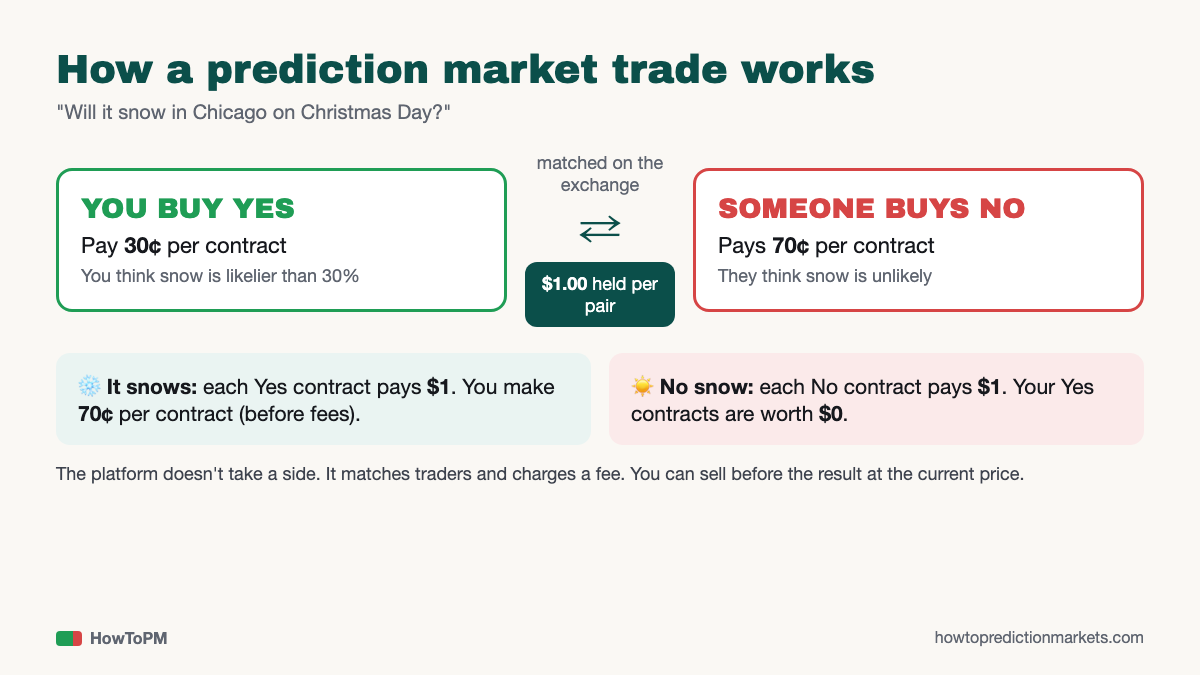
For any question, a Yes contract and a No contract together are always worth exactly $1, because one of them will pay $1 and the other $0. So if Yes costs 62¢, No costs about 38¢. (In practice there's a small gap, called the spread, between the buy and sell prices.)
3. The price is the probability
Because a contract pays $1, its price in cents reads like a percentage:
| Yes price | What the market is saying |
|---|---|
| 5¢ | Very unlikely, about 5% |
| 50¢ | A coin flip |
| 85¢ | Very likely, about 85% |
More on this in how to read prediction market odds.
4. Who's on the other side?
Other traders. Platforms like Kalshi, Polymarket, ProphetX and Novig match buyers and sellers through an order book, a list of everyone's offers to buy and sell at each price. When you buy Yes at 62¢, someone else is effectively buying No at 38¢. The platform doesn't care who wins; it earns fees.
Some platforms also use market makers, professional firms that post prices on both sides so there's always someone to trade with.
5. Market orders and limit orders
- Market order: "Buy now at the best price available." Fast, but you may pay a bit more.
- Limit order: "Buy only at 60¢ or less." You might not get filled, but you control the price. On some platforms limit orders that wait in the book pay lower fees, or none.
Beginners: use limit orders once you're comfortable. They stop you overpaying in fast-moving markets.
6. You can sell before the end
You don't have to hold until the result. If you bought Yes at 40¢ and news pushes it to 70¢, you can sell for 70¢ and keep the 30¢ profit per contract (minus fees), whatever happens next. You can also sell early to limit a loss.
7. Settlement
After the event, the platform checks the official source named in the rules and settles the market. Winning contracts turn into $1 each in your balance; losing contracts disappear. From there you can trade again or withdraw.
A full worked example
- The market: "Will the Fed cut rates at its December meeting?" Yes is at 35¢.
- You buy 20 Yes contracts with a limit order at 35¢: cost $7.00 plus a small fee.
- A week later an inflation report comes in soft. Yes rises to 55¢.
- Option A: sell now for $11.00, a profit of $4.00 before fees.
- Option B: hold. If the Fed cuts, you get $20.00 (+$13.00). If not, $0 (−$7.00).
Frequently asked questions
Do prediction markets set the odds?
No. On an exchange-style prediction market, traders set the prices by posting orders. The platform only runs the exchange.
What happens if a market is cancelled or unclear?
Each market's rules explain what happens if the event is cancelled or the source is unavailable. Often the market settles at a set price or refunds positions. Read the rules before you trade.
Can I trade on my phone?
Yes. Kalshi, OG, ProphetX, Novig and Rebet have mobile apps, and Polymarket's US app is on iPhone.
What does "liquidity" mean?
How much money is waiting in the order book. High liquidity means you can buy or sell quickly without moving the price much. Big political and sports markets are usually the most liquid.